The Wooden Drawer That Held Everything You Needed to Know
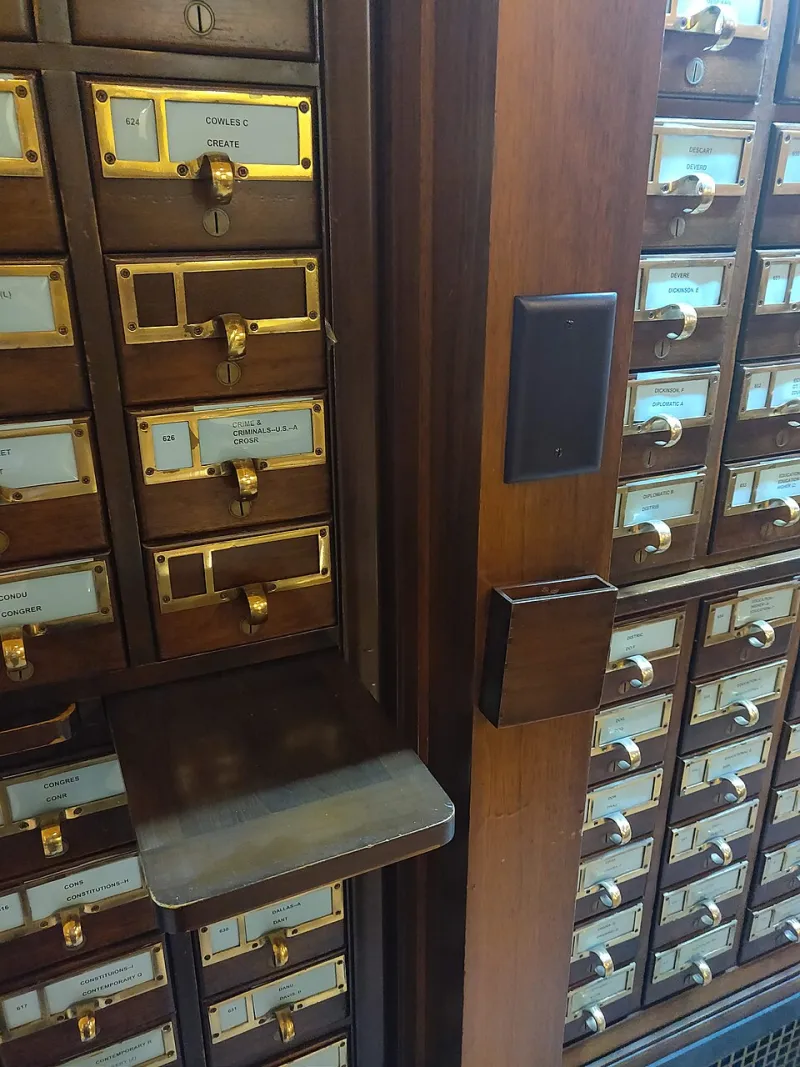
Photo: TBurmeister (WMF), CC BY-SA 4.0, via Wikimedia Commons
The card catalog sat at the center of every public library like a piece of furniture that was also a philosophy. Rows of small wooden drawers, each one labeled with a range of letters. Inside, thousands of index cards, typed or handwritten, organized with a precision that took years to learn and minutes to appreciate. If you wanted to find something, you started there.
For most Americans born before 1985, this was simply how research worked. Not as a limitation — just as the reality of the world. Information existed, and finding it required effort, patience, and usually a librarian.
The Physical Architecture of Knowledge
To understand what pre-internet research actually felt like, you have to understand the full ecosystem. The card catalog was just the entry point.
A standard library card catalog organized books three ways: by author, by title, and by subject. Each card listed the book's call number — the address on the shelf — along with basic publication details and sometimes a brief description. If you were researching, say, the history of the American railroad system, you'd flip through the subject drawers, note the relevant call numbers on a scrap of paper, and then walk the stacks to find the actual books. Some would be checked out. Some would be misshelved. Some would be exactly what you needed.
Beyond books, there were periodical indexes — thick printed volumes published annually that catalogued articles from hundreds of magazines and newspapers by subject and author. The Reader's Guide to Periodical Literature was the most widely used. To find a magazine article on a topic, you'd consult the relevant volume, note the citation, and then locate the actual magazine — either on the shelf or, for older issues, on microfiche.
 Photo: Reader's Guide to Periodical Literature, via m.media-amazon.com
Microfiche deserves its own moment of recognition. Newspapers and older periodicals were preserved on small sheets of transparent film, each one containing dozens of miniaturized pages. You loaded them into a reader — a large, slightly temperamental machine that projected the images onto a screen — and scrolled through manually. Finding a specific article required knowing roughly which issue it appeared in, then scanning page by page. It was painstaking. It was also, for anyone who got good at it, strangely meditative.
The Human Search Engine
None of this system worked well without librarians, and it's worth being specific about what they actually did.
A reference librarian in 1975 was a trained professional with a graduate degree in library science and, typically, deep subject expertise in one or more fields. They knew the collection intimately. They understood Boolean search logic before computers made it automatic. They could look at a research question, identify the three or four most efficient paths to an answer, and save a researcher hours of wandering.
For students working on papers, journalists tracking down historical records, lawyers researching case precedents, or just curious people trying to understand something that puzzled them, the reference librarian was often the difference between finding what you needed and giving up. They were, in a very real sense, the interface between the human and the information.
This role was so central to library culture that it generated its own professional literature, its own conferences, its own ethics around source verification and research integrity. The reference interview — the structured conversation a librarian would conduct to clarify exactly what a patron needed — was a recognized professional skill with its own pedagogy.
What Research Demanded
The practical demands of pre-internet research shaped the way people thought about information in ways that are easy to underestimate.
First, it required commitment. You didn't casually look something up. You made a trip to the library, set aside time, and worked through a process. That friction meant people tended to be more deliberate about what they were actually trying to find. The question had to be worth the effort.
Second, it forced engagement with primary and secondary sources in a way that Google simply doesn't replicate. When you physically held a book, read its table of contents, skimmed its index, and read the relevant sections, you absorbed context that a search result excerpt can't provide. You encountered the argument, not just the conclusion.
Third, and perhaps most importantly, it trained a particular kind of skepticism. Because sources were finite and physically present, researchers learned to evaluate them. Who published this? When? What's the author's background? Does this encyclopedia entry cite its sources? These questions weren't abstract — they were practical necessities.
The Staggering Scale of What Changed
The arrival of the internet didn't just speed up research. It restructured the entire relationship between humans and information.
The first major shift came with online databases in the late 1980s and early 90s — systems like DIALOG and LexisNexis that allowed keyword searching of massive text archives. These were initially expensive and required training to use effectively, but they pointed toward what was coming.
By the late 1990s, search engines had arrived. By the mid-2000s, Google had effectively won. By 2010, a college student who had never touched a card catalog or a microfiche reader was the norm rather than the exception.
Today, the sum total of human recorded knowledge is accessible from a phone in your pocket, retrievable in under a second. The scale of that change is genuinely difficult to process. A researcher in 1970 with access to the best university library in the country had access to perhaps a few million documents. A person with a smartphone today has access to more information than all the world's libraries combined contained in that era.
The Thing That Got Quieter
What's harder to measure is what the friction of the old system produced that the frictionless new system doesn't.
There's evidence that slower, more effortful information retrieval produces better retention and deeper understanding. The act of physically searching, cross-referencing, and building a research trail created a kind of cognitive map that passive scrolling doesn't replicate. Students who spent an afternoon in the stacks often came away with not just an answer but a feel for a subject — a sense of how the pieces fit together — that a string of search results rarely provides.
Librarians, for their part, have watched this shift with complicated feelings. The profession hasn't disappeared — it's transformed, focusing more on digital literacy, source evaluation, and information architecture. But the role of the human search engine, the person who knew the collection and could navigate it on your behalf, has largely been absorbed by an algorithm.
The wooden drawers are mostly gone now. A few libraries keep them as artifacts, occasionally as furniture. But what they represented — a physical, navigable architecture of human knowledge, tended by people who understood it intimately — was something genuinely remarkable. The fact that we rarely think about it anymore might be the most remarkable thing of all.