The Corner Where Everyone Knew Your Story
The Democracy of the Barber's Chair
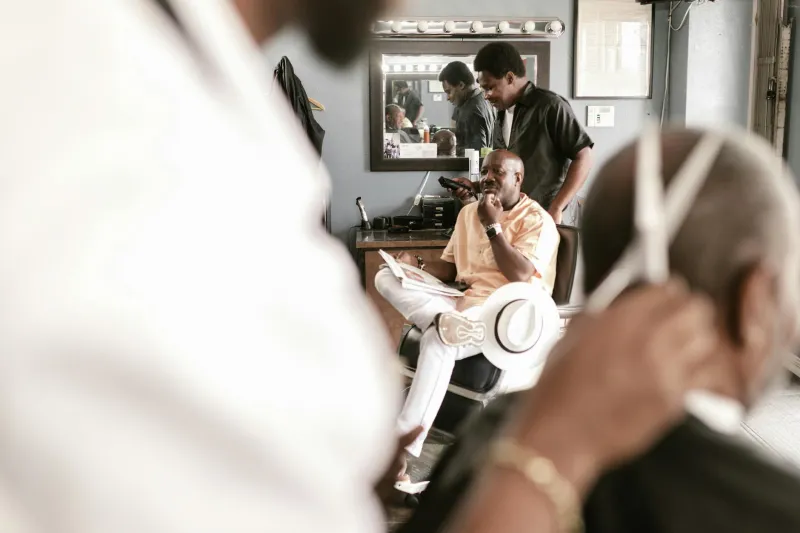
Every Tuesday at 4 PM, three generations of Kowalski men would gather at Eddie's Barbershop on Elm Street. Grandfather Stan got his weekly trim, father Joe discussed the Tigers' latest losing streak, and eight-year-old Mike sat wide-eyed, absorbing neighborhood wisdom from the rotating cast of regulars who treated Eddie's like their personal parliament.
 Photo: Eddie's Barbershop, via i.ytimg.com
These weren't just haircuts—they were civic engagement. In Eddie's chair, the mailman shared gossip, the mechanic offered car advice, and the retired cop told stories that weren't quite appropriate for children but somehow always ended with valuable life lessons. Mike learned more about his neighborhood in those Tuesday afternoons than most kids today learn about theirs in years.
That barbershop closed in 1987, replaced by a chain salon where conversation competes with blow dryers and appointments are scheduled through an app. The Kowalski tradition died with it.
When Commerce Had a Face and a Memory
Mid-century American neighborhoods operated on a simple principle: business was personal. The corner grocery store owner knew your family's preferences, your budget constraints, and your payment history. Mrs. Chen at Chen's Market would set aside the good produce for her regulars, extend credit during tough weeks, and somehow remember that the Johnson kid was allergic to peanuts.
 Photo: Chen's Market, via is2-ssl.mzstatic.com
These weren't just commercial transactions—they were relationship maintenance. Shopping meant catching up on neighborhood news, getting advice about everything from recipes to child-rearing, and participating in an informal information network that kept communities connected.
The economics were inefficient by modern standards. Prices were higher than chain stores, selection was limited, and inventory management was hit-or-miss. But efficiency wasn't the only value being optimized. These places prioritized relationships, community knowledge, and social cohesion.
The Diner as Democracy's Living Room
Walk into Murphy's Diner on any morning in 1965, and you'd find America in microcosm. Construction workers debated politics with bank tellers, retired teachers shared tables with young mothers, and everyone had opinions about everything. The coffee was mediocre, but the conversation was priceless.
Diners served as neutral ground where social mixing happened naturally. Class lines blurred over breakfast, generational wisdom passed across booth tables, and neighborhood issues got hashed out between the eggs and hash browns. These weren't planned community meetings—they were organic democracy in action.
Murphy knew everyone's usual order, their family situations, and their personal struggles. He'd quietly comp a meal for someone going through hard times, mediate disputes between regulars, and serve as an unofficial neighborhood mayor without ever running for office.
The Great Efficiency Revolution
The 1980s brought a revolution in American commerce that prioritized efficiency, selection, and cost savings above all else. Chain stores could offer lower prices through volume purchasing, consistent experiences through standardized procedures, and broader selection through centralized distribution.
Wal-Mart, Home Depot, and McDonald's didn't just compete with local businesses—they redefined what Americans expected from commercial experiences. Why pay more at Chen's Market when the supermarket offered triple the selection at 20% lower prices? Why wait for Murphy to slowly grill your burger when McDonald's could serve it in ninety seconds?
The efficiency gains were real and significant. American families saved money and time, gained access to products that local stores could never stock, and enjoyed consistent quality regardless of location. These weren't trivial improvements—they represented genuine progress in meeting consumer needs.
But something was lost in translation.
When Algorithms Replaced Intuition
Today's commercial experiences optimize for metrics that previous generations never considered: transaction speed, inventory turnover, customer throughput, and profit margins per square foot. Modern retailers know more about your purchasing patterns than Mrs. Chen ever could, but they know nothing about your life circumstances or community connections.
Self-checkout lanes eliminate human interaction entirely. Online shopping removes the need to leave home. Amazon's recommendation algorithms can predict what you'll want to buy next week, but they can't ask about your mother's health or remember that you're trying to lose weight.
We've gained convenience and lost serendipity. Modern commerce is predictable, efficient, and utterly impersonal.
The Social Media Substitute
Proponents of modern life argue that digital platforms have replaced the social functions of neighborhood gathering places. Facebook groups connect neighbors, NextDoor facilitates local information sharing, and Yelp reviews provide community recommendations about local businesses.
These tools offer genuine value and reach people who might never have participated in barbershop conversations or diner debates. Introverts can engage comfortably, working parents can connect despite schedule constraints, and geographic communities can expand beyond walking distance.
But digital interaction lacks crucial elements that made physical gathering places so valuable: spontaneity, cross-generational mixing, and the kind of nuanced communication that only happens face-to-face.
The Coffee Shop Phenomenon
Starbucks and independent coffee shops have attempted to recreate some aspects of traditional gathering places. They offer comfortable seating, encourage lingering, and position themselves as "third places" between home and work.
Some succeed in fostering community connections. Regular customers develop relationships with baristas and each other, freelancers form informal coworking communities, and neighborhood meetings find neutral venues for discussion.
But coffee shop culture skews heavily toward certain demographics—college-educated, laptop-carrying, latte-drinking Americans. They rarely achieve the broad social mixing that made diners and barbershops such effective community centers.
The Unintended Consequences of Optimization
When we optimized commerce for efficiency and cost, we inadvertently optimized away community connection. When we prioritized convenience, we sacrificed serendipity. When we chose predictability, we lost the beautiful messiness of human interaction.
These weren't malicious decisions—they reflected genuine consumer preferences and economic realities. Americans voted with their wallets for lower prices and greater convenience. But they didn't realize they were also voting against informal community infrastructure.
What We Lost in the Translation
The disappearance of neighborhood gathering places represents more than nostalgia for a simpler time. It reflects a fundamental change in how Americans experience community, share information, and form social connections.
Young people today often struggle to find mentors outside formal educational or professional settings. Elderly Americans report increasing social isolation despite living in more densely populated areas than ever before. Political polarization intensifies when people lack neutral spaces for cross-cutting social interaction.
These problems aren't entirely caused by the loss of neighborhood gathering places, but they're certainly exacerbated by it.
The Search for Modern Solutions
Some communities are experimenting with new approaches to neighborhood connection. Community gardens, maker spaces, and neighborhood tool libraries attempt to recreate the social mixing that commercial gathering places once provided. Co-housing developments design physical spaces specifically to encourage casual interaction between neighbors.
These efforts show promise but remain niche experiments rather than widespread solutions. They also tend to attract people who already value community connection rather than creating it organically among diverse populations.
The Efficiency Trap
We've become so efficient at meeting our individual needs that we've forgotten how to meet our collective ones. Modern life offers unprecedented convenience, selection, and cost savings, but it struggles to provide the social glue that holds communities together.
The challenge isn't returning to the past—Mrs. Chen's Market and Murphy's Diner aren't coming back, nor should they. Instead, we need to figure out how to capture some of their social value while maintaining the economic progress we've achieved.
Because efficiency without community isn't really progress at all—it's just faster loneliness.