The Last Generation That Could Read a Map: How America Lost Its Way to Find Its Way
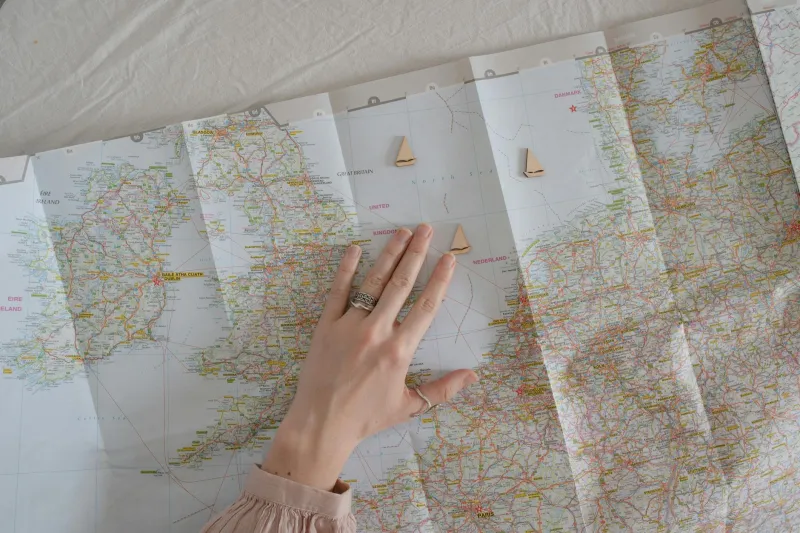
In 1995, Sarah Chen planned a cross-country road trip from Boston to Seattle using a stack of AAA TripTiks—those spiral-bound booklets of strip maps that guided millions of American journeys. She spent hours at the kitchen table, highlighter in hand, tracing routes and circling landmarks. Gas stations. Water towers. The peculiar barn shaped like a shoe outside Topeka. She memorized exit numbers and noted backup routes in case of construction.
The trip took six days. She got lost twice—once spectacularly, adding 200 miles through rural Nebraska—but found her way both times using road signs, gas station attendants, and her own developing sense of direction. By the end, she could navigate downtown Seattle without looking at a map.
Last month, Sarah's daughter Emma made the same drive using Google Maps. She arrived three hours faster, taking optimal routes Sarah never could have discovered. But when Emma's phone died outside Denver, she sat paralyzed in a parking lot, unable to figure out which direction led home. She'd driven 1,200 miles without learning a single landmark or developing any spatial awareness of where she'd been.
The difference between these two journeys reveals one of the most subtle yet profound changes in modern American life: we've outsourced navigation to machines, and in doing so, we've fundamentally altered how our brains understand space and place.
When Getting Lost Was Normal
For most of human history, navigation was survival. Our ancestors developed sophisticated mental maps of their territories, reading landscapes like books and passing spatial knowledge through generations. American pioneers crossed the continent using the sun, stars, and an intuitive understanding of geography that seems almost superhuman today.
Even into the 1990s, ordinary Americans possessed navigation skills that would astound the GPS generation. They could estimate distances by eye, orient themselves using the sun's position, and maintain a mental map of their location even during complex multi-turn journeys.
Getting lost wasn't a disaster—it was an education. Wrong turns led to discoveries: roadside diners, scenic overlooks, small towns with surprising histories. Americans developed what researchers now call "survey knowledge"—the ability to understand spatial relationships from a bird's-eye perspective, like looking down at a map of the territory in your mind.
The Paper Map Renaissance
Road atlases were treasured possessions. Rand McNally sold millions annually. Families kept them in glove compartments, consulted them at rest stops, and argued over the best routes during vacation planning. Gas stations employed attendants who could give directions to anywhere within a 50-mile radius.
These paper maps taught spatial thinking in ways GPS never could. Users had to understand scale, orient themselves within larger geographical contexts, and plan routes by visualizing the relationship between distant points. The act of tracing a finger across paper created mental pathways that lasted for decades.
Dr. Julia Frankenstein, a cognitive scientist studying navigation, explains: "When you use a paper map, you're forced to engage with geography. You see how roads connect, where cities sit in relation to mountains and rivers, why certain routes exist. GPS just tells you the next turn."
The Neuroscience of Navigation
Recent brain imaging studies reveal that GPS dependency is literally reshaping human cognition. The hippocampus—the brain region responsible for spatial memory and navigation—shows measurably less activity in people who rely on turn-by-turn directions compared to those who navigate independently.
London taxi drivers, famous for memorizing the city's 25,000 streets without GPS assistance, have enlarged hippocampi compared to average people. But GPS-dependent drivers show the opposite pattern: their spatial processing areas actually shrink with disuse.
This isn't just about finding destinations. The hippocampus also plays crucial roles in memory formation and creativity. Some researchers worry that outsourcing navigation might affect broader cognitive abilities, though the long-term implications remain unclear.
The Death of Serendipity
GPS doesn't just change how we navigate—it changes what we discover. Algorithm-optimized routes prioritize efficiency over experience, guiding millions of travelers along identical paths while bypassing the unexpected encounters that once defined American road trips.
The "scenic route" has become an anachronism. Why take the winding road through small-town Main Streets when GPS can shave fifteen minutes off your journey via the interstate bypass? Tourism patterns now concentrate along GPS-preferred corridors, while equally interesting areas just miles away see dramatically reduced visitor traffic.
Restaurant owner Mike Torres in Flagstaff, Arizona, remembers the change: "In the '90s, people would wander into town because they got lost or saw our sign from the highway. They'd discover us by accident and become regular customers. Now GPS routes everyone straight past us. We had to completely change our marketing strategy."
The Anxiety of Independence
Today's Americans have developed what researchers call "GPS anxiety"—genuine distress when forced to navigate without technological assistance. Studies show that people become measurably more stressed when their GPS fails compared to pre-smartphone generations encountering similar navigation challenges.
This learned helplessness extends beyond driving. Young adults struggle with basic spatial tasks that previous generations mastered automatically: estimating distances, understanding cardinal directions, or maintaining awareness of their location within larger geographical contexts.
College campuses report increasing numbers of students who can't find buildings without smartphone assistance, even after months of attendance. The same technology that was supposed to make navigation effortless has made it anxiety-provoking when unavailable.
What We Gained and Lost
GPS technology represents genuine progress. Emergency responders reach destinations faster. Delivery drivers optimize routes impossible to calculate manually. Travelers avoid dangerous areas and navigate unfamiliar cities with confidence.
The efficiency gains are undeniable. What once required careful planning, paper maps, and frequent stops for directions now happens seamlessly. GPS has democratized navigation, making complex journeys accessible to anyone with a smartphone.
But the losses are subtler and more profound. We've traded spatial awareness for convenience, exploration for optimization, and independence for dependency. The generation that grew up with GPS may never develop the intuitive understanding of geography that their grandparents took for granted.
The Cognitive Consequences
Neuroscientist Veronique Bohbot's research suggests that GPS dependency affects more than navigation. People who rely heavily on GPS show different patterns of brain activation during memory tasks and problem-solving exercises. They're more likely to use "response learning"—following habitual patterns—rather than "spatial learning"—understanding relationships and contexts.
This shift may influence how we approach non-navigation challenges. The mental flexibility required to read maps, plan routes, and adapt to unexpected detours might transfer to other areas of life: career planning, relationship navigation, creative problem-solving.
The Road Ahead
Some educators now advocate for "digital detox" navigation exercises: students using paper maps, planning routes manually, and developing spatial awareness through direct experience. A few driving schools have added map-reading components to their curricula, recognizing that GPS dependency creates genuine safety risks when technology fails.
Others argue that fighting GPS adoption is like opposing any technological advance. Why memorize facts when we can Google them? Why develop spatial skills when machines navigate better than humans ever could?
Finding Our Way Forward
The GPS revolution represents more than technological convenience—it's a fundamental shift in how humans relate to space and place. We've gained efficiency but lost something harder to quantify: the deep satisfaction of finding our own way, the confidence that comes from spatial mastery, and the serendipitous discoveries that happen when we occasionally get lost.
Emma Chen may never develop her mother's intuitive sense of geography. But she can travel anywhere in the world with confidence, access real-time traffic data, and avoid the frustration of wrong turns that once defined American road trips.
Whether this trade-off represents progress or loss depends on what we value: the security of never being truly lost, or the adventure of finding our own way home.
The last generation that could read a map is quickly disappearing, taking with them a particular kind of spatial intelligence that may never return. In learning to trust machines to find our way, we may have lost something essentially human: the ability to know where we are without being told.