Six O'Clock and Everyone Was There: The Family Dinner That Quietly Stopped Happening
The Table That Organized Everything Else
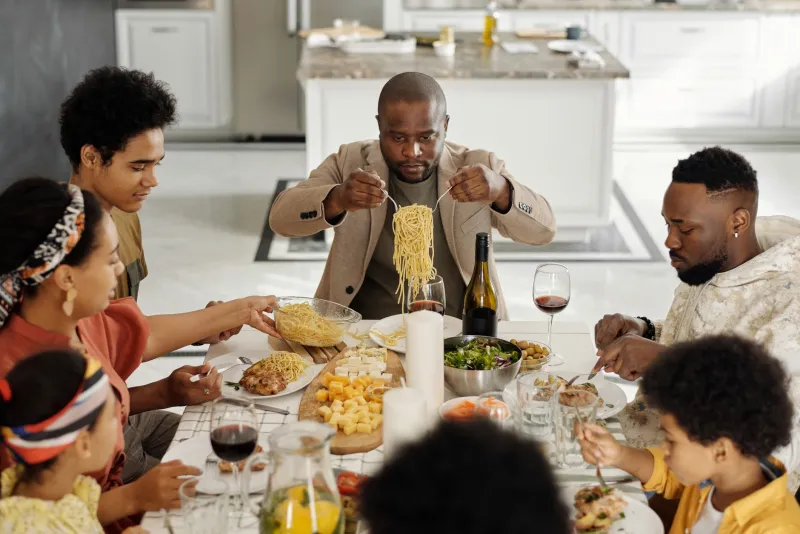
Not that long ago, dinner wasn't a decision. It was six o'clock, and you were at the table. No negotiation, no alternatives, no eating in your room. Whatever else was happening in the house — whatever conflict, whatever stress, whatever silence — the family came together around food once a day.
For much of the twentieth century, this was the default American experience. Not a special occasion. Not something families had to schedule or protect. Just Tuesday night.
That default is gone for most American families now. And the shift happened so gradually that many people didn't notice it leaving.
What the Dinner Table Actually Was
The family dinner served functions that weren't always obvious in the moment. On the surface, it was just a meal. But underneath, it was a daily check-in — a structured moment where parents knew where their kids were, where siblings updated each other on their separate lives, where the family processed the day together.
Research has consistently supported what many people intuitively understood. Studies from the National Center on Addiction and Substance Abuse at Columbia University found that teenagers who ate dinner with their families five or more times per week were significantly less likely to use drugs, alcohol, or tobacco. Other research linked regular family dinners to better academic performance, lower rates of depression in adolescents, and stronger communication skills in children.
The dinner table was also where culture got transmitted. Grandparents told stories. Parents modeled conversation. Kids learned how to disagree without leaving, how to listen while waiting their turn, how to be part of something larger than themselves.
This wasn't therapy. It was just dinner. But it did the work of connection in a way that nothing has fully replaced.
How It Fell Apart
No single thing dismantled the family dinner. It was a slow accumulation of changes that each seemed reasonable on their own.
Work schedules stretched. The two-income household became the American norm, which meant that the parent who used to be home at five o'clock was now getting home at six-thirty or seven. Commutes lengthened as suburban sprawl pushed families further from city centers. A 2019 study found that the average American commuter spent 27 minutes each way getting to work — and in major metro areas, that number was significantly higher.
Then came the activities. Soccer practice on Tuesdays. Piano on Thursdays. Travel sports teams that consumed entire weekends. American parents in the late twentieth century began optimizing their children's schedules in ways that previous generations hadn't, filling after-school hours with structured enrichment. The intention was good. The side effect was that the family rarely landed in the same place at the same time.
And then the screens arrived. Television had already been pulling attention away from the dinner table for decades — some families moved their meals to the living room to eat in front of the nightly news. But smartphones and streaming services completed the fragmentation. By the 2010s, many households contained multiple people, each consuming entirely separate content on entirely separate devices, in entirely separate rooms.
The Microwave and the Myth of Convenience
Food itself changed in ways that made communal eating less necessary. The rise of convenience foods, microwaveable meals, and fast food meant that eating no longer required collective effort or a set time. Anyone could eat anything at any time with minimal preparation. The ritual of cooking together — which had its own connective function — faded for many families.
Door Dash and Uber Eats completed what the microwave started. A family of four can now order four completely different meals from four different restaurants and eat them on four different schedules without anyone ever sitting at the same table.
This is framed as freedom. And in some ways, it is. But freedom from shared meals is also freedom from the particular kind of connection that shared meals created.
What the Research Is Actually Saying
The data on family dinners isn't ambiguous. The Harvard Family Dinner Project, which has compiled years of research on the topic, found that shared family meals are one of the strongest predictors of child wellbeing — stronger than many of the extracurricular activities that displaced them in the first place.
Adolescents who regularly eat with their families report feeling more connected, more supported, and more able to talk to their parents about difficult topics. They're more likely to eat healthier food, which matters for long-term health outcomes. They're less likely to report symptoms of anxiety and depression.
And the effect isn't just on kids. Adults who eat with family members report lower stress levels and greater feelings of belonging. The dinner table, it turns out, was doing a lot of invisible emotional labor.
The Ritual Nobody Thought to Protect
Here's what's striking about the decline of the family dinner: nobody decided to get rid of it. It wasn't a conscious cultural choice. It was the cumulative result of longer work hours, busier schedules, more entertainment options, and more convenient food — all of which seemed like progress in isolation.
But progress toward what? We now live in a moment when family members can be physically present in the same house for an entire evening without ever actually being in the same room. When teenagers eat dinner alone in their bedrooms while texting friends they'll see at school tomorrow. When parents eat leftovers at ten o'clock after the kids are already asleep.
None of this is anyone's fault. But it's worth being honest about what it costs.
The dinner table didn't just hold food. It held the family together, once a day, whether anyone felt like it or not. That friction — the obligation to show up, sit down, and be present — turned out to be more valuable than it looked at the time.
Six o'clock used to mean something. It's worth asking whether anything has taken its place.